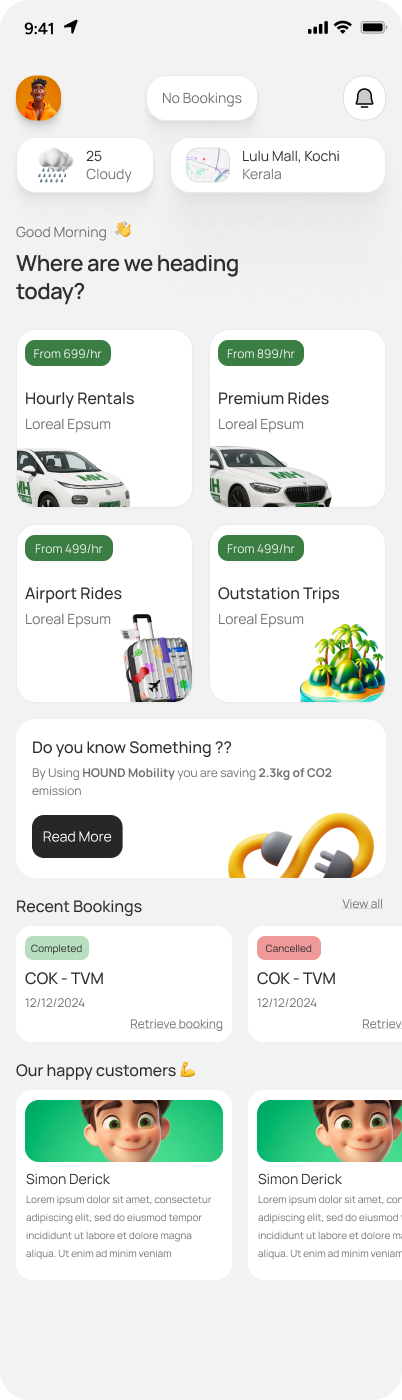
Overview
A full-stack ride-hailing product for an EV-first fleet (rider app, driver app, and a real-time dispatch console), built to match the quality of the incumbents and win on an all-electric fleet.
The challenge
Compete with Uber on product. Win on sustainability.
Ride-hailing is owned by giants with a decade of product work and billions in the bank. You don't out-spend that, and you don't out-discount it either. Hound's brief was honest about the maths: match the product quality people already expect from the big apps, then win on the one thing the incumbents can't switch on overnight: an all-electric fleet.
Electric wasn't the marketing line; it was the constraint that shaped everything. A driver can't accept a fare that would strand them at 4%. A rider needs to believe the car won't quietly die on the motorway. So range and charging couldn't be a badge bolted on at the end. They had to sit underneath the routing, the dispatch logic and the rider's ETA.
Then dispatch. A small ops team needed the kind of live picture a major fleet operator takes for granted: every driver's location, every battery level, every active ride, on one screen legible enough that nobody needs an analyst to translate it during a busy Friday night.
What was hard: three real-time surfaces all leaning on the same live location and battery data is a lot of moving parts for one build window, and every one of them breaks in a different way when the data hiccups. We made a deliberate call to nail the rider and driver apps first and ship the dispatch console with a focused, opinionated feature set rather than every report an operator might someday ask for. If we ran it again, we'd lock the charging-station data source down in week one. Stitching together a reliable, current map of where you can actually charge ate far more time than the brief implied. The EV world is still messier than the apps make it look.
What we did
Designed a rider app built around confidence: live tracking, a visible range indicator, and eco-credits that build toward real discounts.
Built a driver app that puts earnings front and centre, surfaces charging stops before the battery gets anxious, and matches fares by remaining range, not just distance.
Built a dispatch console that puts driver locations, battery health, and active rides on a single screen, legible without a data analyst on hand.
Integrated driver onboarding (document upload, background-check, and vehicle registration) into one flow instead of a week-long paper trail.
The outcome
Three connected surfaces shipped: rider app, driver app, and a real-time dispatch console sharing one data model and one live source of location and battery data.
Electric-first, not EV-flavoured: range, charge, and charging stops are built into the core, with jobs matched by remaining range so drivers aren't handed fares they can't finish.
Real-time fleet dispatch a small ops team can run unaided, with full IP and design source handed over. Launched on schedule.
Tech & stack
React Native · Next.js · Supabase · real-time location